Friday, 13 May 2016

IBM Interconnect
Quantum Computing has for 35 years been a key focus for the techno-giants, in 1981 IBM and MIT jointly hosted the very first quantum computing conference. Quantum computing is based upon quantum physics and fundamentally nature as for over a century it has been established that nature’s building blocks obey the laws of quantum physics and so in 1981, Nobel Laureate Richard Feynman urged scientists to build a computer according to quantum mechanics so we could then simulate nature, this of course was after Paul Benioff first applied the quantum theory to computers theorizing about creating a quantum Turing Machine.
Consequently for over 20 years IBM maintained a research lab dedicated to the cause as they believe that current digital electronic computers based on transistors are almost fulfilled and so, more than wanton, the next step is required. It is of such significance that the research is recognized and compared to that of the space race, where IBM were also were a critical cog.
On May the 4th 2016 IBM announced the breakthrough. They have opened quantum computing capabilities to researchers and scientists around the world, who can now access IBM’s five-qubit quantum processor on any desktop or mobile device by utilizing the IBM Quantum Experience which is the first of its kind delivered on the Bluemix platform via the IBM Cloud. The crucial piece of this hugely complex puzzle has been the lack of hardware to test theories and ideas which IBM’s quantum systems now provide through the Bluemix portal. The portal allows users to run and test algorithms and experiments on IBM’s quantum processor working with individual qubits and explore resources of just what quantum computing maybe able to permit.
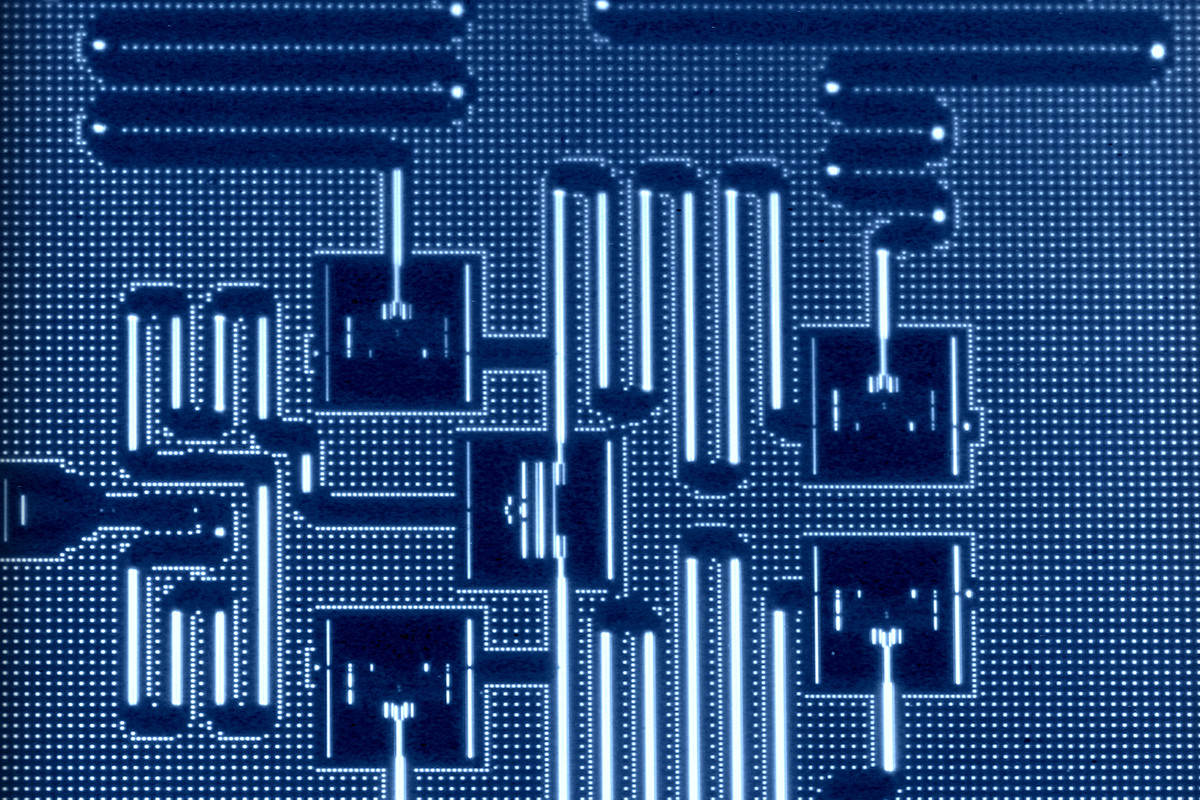
Credit: IBM- IBMs five-qubit processor

But what is Quantum computing?

The computer you are reading this one works in 1’s and 0’s, on or off on a binary basis, but quantum states allow for much more complex information to be encoded in to a much smaller computer, going by Moore’s Law in that the number of transistors on a microprocessor doubles every 18 months, by 2020 or 2030 the number of circuits on a microprocessor will have to be measured on an atomic scale. Quantum computers will then harness the power of atoms and molecules to perform calculations much faster than any silicon-based setup.
The 1’s and 0’s in a quantum computer can be both at the same time or superposition’s of, so whilst a normal computer can manipulate data in either 1 or 0 states, quantum computers aren’t limited to the 2 states instead they can work on every superposition and effectively every point in between. The quintessential point is that instead of digital computers which only workout the correct action, or solution to a proposed problem, quantum computers will calculate every possible answer and analyse the most appropriate at lightning speeds.

To put that simply…

Because these atoms can be programmed to represent all input combinations- doing so simultaneously- when an algorithm is ran all possible input combinations are tested at once, whereas with a regular computer you’d have to serially cycle through every possible input combination before discovering the solution which for some of the most complicated calculations would take an age... continue reading

Tuesday, 10 May 2016

Touchscreen devices are everywhere to be seen these days, largely thanks to the advent of smartphones and tablet computers from the highly desirable Apple conveyor belt.  However, prior to the explosion in the consumer market, the touchscreen has long been a staple component in Industrial computing applications such as factory automation and control.  These traditional arenas tended to demand certain types of touch technology, however, as their popularity has increased in the mass market, so has the amount of technology types in which we have to choose from.
Assured Systems recognises that this makes for a difficult decision when choosing your hardware, so we’ve compiled a guide to the main technologies identifying their features & benefits.
Touchscreen technology

Resistive

Resistive touchscreen technology is composed of two flexible sheets coated with a resistive material and separated by an air gap or microdots.  When these element touch together, they register the precise location and enable the connected computer to determine which part of the screen has been touched and undertake the appropriate instruction.  As resistive technology requires physical contact, the touchscreen senses inputs from any input device.
Features  
  • Can be sealed to IP65
  • Fast touch response
  • Finger, fingernail, gloved hand, pen, swipe-card, or any other stylus activation
  • Excellent durability (5-Wire or above)
  • Continues to work with liquids and other contaminants on the screen
  • Competitive price point
Main Limitations 
  • Does not scale to large displays easily
  • Not recommended for sunlight readable transflective displays
  • Susceptible to vandalism, can be scratched

Surface Acoustic Wave (SAW)

Surface acoustic wave (SAW) technology uses ultrasonic waves that pass over the touchscreen panel. When the panel is touched, a portion of the wave is absorbed. This change in the ultrasonic waves registers the position of the touch event and sends this information to the controller for processing.
Features
  • Pure-glass touchscreen for superior image clarity, brightness, and light transmission 
  • Scalable to larger screen displays
  • Can be sealed to IP64 
  • Durable, scratch-resistant glass surface 
  • Unaffected by static water droplets and scratches on the screen 
  • Touch response faster than human perception 
  • Finger or gloved-hand activation 
Main Limitations
  • Can be susceptible to electrical noise
  • Some SAW touchscreens can only be sealed to IP54

Infrared

An infrared touchscreen uses an array of X-Y infrared LED and photodetector pairs around the edges of the screen to detect a disruption in the pattern of LED beams. These LED beams cross each other in vertical and horizontal patterns. This helps the sensors pick up the exact location of the touch. A major benefit of such a system is that it can detect essentially any input including a finger, gloved finger, stylus or pen.
Features
  • Shock resistant
  • Can be sealed to IP65 
  • Finger, gloved-hand, or any other stylus activation 
  • Stable, drift-free operation for an accurate touch response
  • Operation unaffected by direct sunlight (used in new touch based Amazon Kindle)
Main Limitations
  • Cost to manufacture bezel
  • Susceptible to false activations from surface contaminants

Surface Capacitive 

A capacitive touchscreen panel consists of an insulator such as glass, coated with a transparent conductor such as indium tin oxide (ITO). As the human body is also an electrical conductor, touching the surface of the screen results in a distortion of the screen's electrostatic field, measurable as a change in capacitance.  From this, the attached computer can register the precise location and enable the connected computer to determine which part of the screen has been touched and undertake the appropriate instruction.

Features
  • Excellent Image Clarity
  • Can be sealed to IP65
  • Sensor resistant to scratches and abrasions. 
  • Continues to work with liquids and other contaminants on the screen
  • Controller responds to quick, light touches, and operates drift-free even in areas of poor grounding
Main Limitations
  • Requires finger touch or specialist glove
  • Not easily scalable to larger displays

Projected Capacitive 

Projected Capacitive Touch (PCT) technology is a variant of capacitive touch technology. All PCT touch screens are made up of a matrix of rows and columns of conductive material, layered on sheet of glass. This can be done either by etching a single conductive layer to form a grid pattern of electrodes, or by etching two separate, perpendicular layers of conductive material with parallel lines or tracks to form a grid. Current applied to this grid creates a uniform electrostatic field, which can be measured. When a conductive object, such as a finger, comes into contact with a PCT panel, it distorts the local electrostatic field at that point. This is measurable as a change in capacitance. If a finger bridges the gap between two of the "tracks", the charge field is further interrupted and detected by the controller. The capacitance can be changed and measured at every individual point on the grid (intersection). Therefore, this system is able to accurately track touches.

Features
  • Perfect for outdoor applications offering protection against the elements
  • Scalable to larger displays
  • Still operational when glass scratched or broken (often seen in iPhones which have been neglected!)
  • Can be used in conjunction with Perspex or vandal resistant glass up to 18mm thick
  • True flat front surface without bezel possible for aesthetically pleasing designs
  • Multi Touch Capability offering touch gesturing feature 
Main Limitations
  • Periodic recalibration can be required
Assured Systems offers the full complement of touch technologies described above through our wide range of Industrial LCD Monitors, available in a variety of different mechanical designs, including Open Frame Monitors, Panel Mount Monitors , IP65 Panel Mount Monitors, Rack Mount Monitors or Chassis Mount Monitors.  If you would like to discuss your project or application in more detail please contact technical sales on +44 1785 87 90 50 (EMEA) +1 864 421 6991 (USA) or email us at sales@assured-systems.com and one of our qualified sales team will be happy to offer advice on the technology that best fits your project.

About Assured Systems

Assured Systems is a leading British technology company offering high quality and innovative applied computing solutions to the embedded, industrial, and digital-out-of-home markets across the United Kingdom and Ireland. Our impressive product portfolio includes a full range of Fanless Embedded Computer Systems, Digital Signage & Multimedia Computer Systems, Touchscreen Panel PCs, Human Machine Interfaces, Vehicle Mount Computers, Rackmount Computer Systems, Single Board Computers, Rugged Laptops & Tablets.

Thursday, 5 May 2016

Wall mount and freestanding outdoor digital signage displays
The new SureView range of outdoor digital signage displays are designed for use in harsh environments, typically outdoors, allowing customers to display engaging advertising content in areas impossible with a standard LCD monitor. Available in freestanding and wall or pole mount designs, the systems are built to the highest specification and some of the features are listed below:

Sunlight Readable

Locating LCD displays outdoors always offers the difficulty of changing light conditions. Our SureView outdoor digital signage displays offer up to 1500 cd/m2 brightness so they can be viewed even in direct sunlight. A clever light sensor allows the display to adjust its brightness depending on light levels and allow comfortable viewing at night.

Weatherproof Design

The outer casing has been designed to look slick and offer protection against the elements. The system is made from mild steel and complies to IP65 standards for protection against both moisture and dust alongside anti-corrosion properties for long-life outdoors.

Vandal Proof

The SureView range is made from quality mild steel with anti-reflective thermally toughened glass on the front offering maximum protection against vandalism when located in unmanned areas. All the controls and openings are hidden and not easily accessible for increased security. 

Thermal Control

The range features an integrated air-conditioning solution which allows systems to remain cool in summer and warm in winder conditions, allowing use in almost all locations.

Built-in Media Player

The SureView range also includes a built-in media player which can be updated either by USB or can be network enabled and content can be controlled centrally via a cloud-based portal. The systems also have a space for a separate media player or digital signage computer should that be required. 

Touchscreen Option

The systems have a touchscreen option for interactive applications and point of information.
Please see the full range of outdoor digital signage display specifications.  Our experienced sales team can offer the most up to date information and suggest options which fit your specification and budget; depending on location, please call the numbers listed at the top of the page or use the contact form to send us your requirements.
Wall mount outdoor digital signage screens

About Assured Systems

Assured Systems is a leading technology company offering high quality and innovative applied computing solutions to the embedded, industrial, and digital-out-of-home markets across the world. Headquartered in Stone, England and with offices in North America and the UAE (coming 2015), our reach is truly global. Our impressive product portfolio includes a full range of Fanless Embedded Computer Systems, Digital Signage & Multimedia Computer Systems, Touchscreen Panel PCs, Human Machine Interfaces, Vehicle Mount Computers, Rackmount Computer Systems, Single Board Computers, Rugged Laptops & Tablets. Please call the numbers listed or visit our website at www.assured-systems.com for more information.


Microsoft Windows Embedded Vs Windows 10 IoT 

At CES this year, there was only one topic that caused any sort of stir, which of course was the IoT where leading lights such as Intel, Samsung and Firefox unveiled in depth strategies to outline the IoT in their respective industries and how they plan to realise its potential- which beyond any shadow of a doubt is the question at the forefront of research and development at all scales of enterprise throughout the world. Since CES moves from Microsoft, Amazon and Facebook have further highlighted the opportunity at hand and the awaiting fortunes at the other end.

Microsoft’s cloud platform was updated last year for an IoT specific audience courtesy of the Azure IoT Suite which quintessentially equates to an online business tool to manage and control connected devices regardless of their deployments. The IoT platform serves to provide a range of services to facilitate definitive projects such as remote monitoring, asset management and predictive maintenance with the collected intelligence of Azures artificial intelligence to assist the technicians of whom will keep it ticking, analysing relevant data and responding with appropriate decisions all within the cloud based management Portal. Microsoft has reiterated in what will be a monumental battle for IoT domination by acquiring Solair, a company whose focus is commercial IoT services monitoring and ensuring the smooth functionality of machinery and equipment- Solair’s technology will be incorporated into the Azure platform to further strengthen its armoury.

 Windows Embedded has for long been the isolated solution for industrial users building systems that don’t require all the features of a full windows install however upon the release of Windows 10 last year an IoT based alternative of Windows 10 has been promised. Windows 10 IoT is likely to become the impending replacement of the embedded platform that has ruled specialized systems for so long, the key benefits of Embedded were that it enabled enhanced levels of customization and optimized storage space savings- Microsoft are loyal to their platforms and so those key features remain but with the addition of the Windows IoT Core that quite simply offers the option to completely eradicate any traces of a graphical user interface (GUI).

Our clients are much attuned with Windows Embedded- but the new Windows 10 IoT does accommodate functionality that perhaps surpasses its predecessor. Microsoft Windows 10 IoT Mobile Enterprise is a feature attuned towards retail enterprise for mobile and handheld point of sale devices. Windows 10 IoT core is categorically aimed for custom development on small embedded and single board computers. There is a vast movement of designers and aficionados just to make and modify their own versions of major platforms, this is clearly a key indicator for Microsoft who are focusing more towards those who don’t require a screen or graphical output altogether.

Windows Embedded- The New, the Old, the difference

Windows Embedded systems typically fall into either Modular, Full and License only divisions, the modularity is great for those (such as the industrial field) that require only certain features for a specific deployment allowing developers to choose between features as well as custom splash screen branding and filters, Windows Embedded Standard 7 worked on 3 licensing levels- C, E and P with C being the entry level and P comprising of an all-inclusive Windows 7 Embedded system, Windows Embedded Standard 8 worked very similarly with only the most expensive- license P- being the only available.

Therefore it seems that Windows 10 IoT Core is more aimed towards developers, seemingly reinforced by the Windows IT Core Starter Kit which is designed to show you and new developers around thanks to their partnership with Adafruit. Full Windows Embedded Systems differ from the modular variant as evidently in the full option all typical windows functionality is integrated alongside pre-built OS image and additional embedded functions such as filters and branding. Two previous options in this division of embedded standards are Windows Embedded POSReady 7 and Windows Embedded 8.1 Industry, whilst the latest Windows 10 IoT Enterprise provides the full option with an alternate specially targeted towards retail or thin clients, which is marginally less expensive without limiting features like previous formats (WE7S) but can only be used in specific system applications such as retail, thin client or digital signage.

Finally (on the various formats of Windows Embedded) is the License-only options these are software-identical to the standard OEM OS the only difference is effectively the license agreement in that these identical systems can then be used  in embedded applications, which only entails that it must be a part of a larger network or device. Windows 7 Professional for Embedded Systems and....Read more here

Wednesday, 4 May 2016

Royal London Hospital Pioneers VR Surgery
In what was a global first, yesterday Dr Shafi Ahmed- a cancer surgeon at the Royal London Hospital- continued to pioneer VR surgery after broadcasting the first live surgery in virtual reality ever seen, he has used such technology before and is a firm endorser with Google Glass used for a similar experience in 2014 before its demise.
The live surgery is courtesy of a quite impressive effort between Barts Health, Medical Realities, Dr Ahmed’s own VR healthcare training enterprise and Mativision. The stream was open to viewing for thousands of medical students and whilst the Oculus struggles to get its feet anywhere near the ground it is Google’s 10 pound Cardboard and sponsored cheaper alternatives that are actually turning heads, opening the technology up through an affordable and easy-to-use technique for thousands to exploit. Google Cardboard Virtual Reality The patient was a British man in his 70’s with colon cancer and is to be streamed mainly for educational purposes in Universities around the world, gifting them the opportunity to observe some of the finest surgeons from thousands of miles away. It is a testament to the competence and opportunistic nature of this new age of technology, filmed on two 360 degree cameras broadcast a minute behind real-time in order to compensate for any unforeseen complications.
The images allow for viewers to zoom-in in their own time whilst having the freedom to move around the theatre with ease. It is not just a teaching matter though as Dr Ahmed had assistance from selected students who had been specially provided with VR headsets in a seminar format to help him through the operation, providing not just a visual experience but an interactive one. Read more here...
Inside view of Virtual Reality Headset


Tuesday, 3 May 2016

HDMI 1.4 vs 2.0

As trends go 4K is a big one. The human eye is only capable of viewing 8K, so the technology giants won’t want to get there too soon, although 4K TV’s have now dropped below 300 sterling and rumours are rife of the details regarding a Sony PS4K and the various features that 4K can exert. 4K is effectively 4x the modern standard of 1080p and although content is currently lacking the quick popularity and price dropping are making it a front-runner as more and more media hardware and software of the future are attuned to the 4K notion.
In electronic advertising the swing is ever more relevant representing the opportunity to display campaigns and content in the glossiest format yet, courtesy of diverse digital signage displays that are compatible with the advancements from touchscreens to huge outdoor screens. Joining the new technology is the slow introduction of HDMI 2.0 that was introduced in late 2013 to begin replacing the previous height of HDMI 1.4. We have a number of 4K compatible embedded PC’s for all of your digital signage applications with a range of stunning screens to accentuate your content way beyond the ancient wonder that was HD.HDMIs via digitaltrends.comOur embedded computers cover almost any adaptation of digital hardware so take for instance our embedded computer platform- NDiS B325  - it has high-quality playback powered by a Intel Celeron N3150 processor with low consumption to maximize efficiency and content display, minimizing your costs whilst broadcasting your advertising campaigns. Its fanless, solid state design coupled with its wide temperature range permits usage in practically any environment letting you advertise wherever you need with no meithering over the reliability of your hardware.
Along with its heavy-duty capabilities is its 4K compatibility via HDMI 1.4. HDMI 1.4 was introduced with the relevant bandwidth in 2009 for 4K content, 7 years ago it was introduced as a hefty upgrade by the HDMI Licensing Consortium and provided a fantastic solution for a variety of display applications including 4K, 2K as well as an integrated Ethernet channel but this latest advancement revolves solely around the speed that content can be delivered and so the competence in delivering extremely high resolutions. HDMI 1.4 can deliver 10.2 Gbps and its bandwidth is large enough to provide 24 & 30 frames per second think of it as the entry level with the ability to have a dabble with any content such as 4K.
What is HDMI 2.0?
With such high development and research into the various visual formats further applications and evolutions in content mean that a new HDMI doesn’t necessarily extinguish the 1.4 but at 50 & 60fps HDMI 2.0 offers all that content without any compromise including speeds of 18Gbps. Gladly the change is fairly minimal with standard HDMI 1.4 cables that will work smoothly with the new devices. Of course a major application is in films where various new technologies and techniques are creating break-away industries. Peter Jackson’s “The Hobbit” was shot in 48fps which is of huge transition from traditional cinema. It is a swing that inevitable emphasizes the potential for advertising applications to show new, clerical unmissable content to your audience. All that has to be ensured is that either end of the entertainment chain/ hardware support the new standard.HDMI infographic
About Assured Systems
Assured Systems is a leading technology company offering high quality and innovative applied computing solutions to the embedded, industrial, and digital-out-of-home markets across the world. Headquartered in Stone, England and with offices in North America, our reach is truly global. Our impressive product portfolio includes a full range of Fanless Embedded Computer Systems, Digital Signage & Multimedia Computer Systems, Touchscreen Panel PCs, Human Machine Interfaces, Vehicle Mount Computers, Rackmount Computer Systems, Single Board Computers, Rugged Laptops & Tablets. Please call the numbers listed above or visit our website at www.assured-systems.com for more information.

Friday, 29 April 2016

The PS4K- A 4K Fad or HDR Fruition
The 4K revolution is only just beginning. Seemingly it is having a massive effect with its mainstream integration coinciding with that of Virtual Reality. It’s having an inspiring impact with huge corporations and SMEs alike investigating their own applications and developments, developments that are projected to be a part of our daily rituals whether we like it or not, for instance if you didn’t know, Netflix now offer 4K streaming for an additional charge. Just as with any technology initial teething problems eventually pave way to the front-line tech we all love to have.
4K Myth
After the Xbox One and PS4 released last year prices are falling to more affordable rates whilst neither offer a 4K output the Roku 4 or the NVIDIA Shield adaptations are available, or instead step-forward the PS4K. Rumours are very lively at the moment though anything official is yet to be confirmed, however one thing is for sure the PS4K has a bit of a 4K myth. Consoles usually use mid-range GPUs to keep the price down, the current PS4 outputs most games at FullHD resolution which is 1920x1080 (1080P) or 2,073,600 pixels however; 4K (3840x2160) or 8,294,400 pixels is 4x the resolution of HD.

 The problem is no single GPU is capable of 4K rendering high performance games whilst maintaining 60fps- though GPUs in the pipelines of AMD and NVIDIA do promise a generation of GPUs that may well be sufficient, but will come with an appropriate high-end price tag, which will have significant ramifications for any speculative retail price.
Instead the biggest advancement may not be entitled, as PS4HDR doesn’t have quite the same phonetic value. High Dynamic Range rendering is nothing new, but advancements in equivalent displays have been slow, limiting its tangible applications. HDR is essentially the ability to display brighter and darker pixels when necessary allowing for improved contrast and hence, better viewing. This very much involves current changes in television parameters set by the International Telecommunications Union (without them TV would look different on every type of TV) in planning for the future.
The current TV standard Rec.709 was developed in the mid-to-late 90’s, so outdated is at the very least an understatement. Now Rec.2020 is to be introduced after approval in 2012 for UHDTVs supported by the HDMI 2.0 (see here for more information). The main point is the colour where the new format is defined by a 10/12-bit space whilst the outdated Rec.709 was limited to 8-bit.
This change reflects numerically from 16million pixels to just shy of 70billion. The diagram below identifies the Rec.2020 Colour Gamut, the multi-colour curve represents all the colours that the human eye is capable of perceiving, the solid smaller, internal triangle represents that of HDTVs or Rec.709. Rec.2020 however is the larger intermittent triangle of UHDTVs such as 4K or 8K. This development is aimed towards exact parts of the spectrum where human vision is the most acute.
HDR/UHD Colour Gamut Graph
This Colour Gamut goes in hand in hand with HDR and is a part of the reason for the HDMI 2.0a surfacing with added HDR support, whilst Polaris (AMD architecture which the PS4k’s GPU may be based) has been confirmed to have HDMI 2.0a and manufacturers are also looking to incorporate it whilst content providers, Youtube, Netflix and Amazon have announced more HDR content. Microsoft are also big endorsers of HDR with their own tests suggesting it may be a more noticeable difference than standard 4K now that displays have evolved to show it. Due to the HDR data being produced but not visible Microsoft go on to say that engineering work to complete the changes to HDR may only take a week!
In conclusion the chances of games being natively rendered in 4K are highly unlikely, but the deployment of HDR through the PS4K is much more the point. The launch of the PS4K is rumored to be in the first quarter of 2017, though plenty of rumours indicate that the truth is that this is only likely to bolster the popularity of 4K technology in preparation for the eventual launch.

Assured Systems is a leading technology company offering high quality and innovative applied computing solutions to the embedded, industrial, and digital-out-of-home markets across the world. Headquartered in Stone, England and with offices in North America, our reach is truly global. Our impressive product portfolio includes a full range of Fanless Embedded Computer Systems, Digital Signage & Multimedia Computer Systems, Touchscreen Panel PCs, Human Machine Interfaces, Vehicle Mount Computers, Rackmount Computer Systems, Single Board Computers, Rugged Laptops & Tablets. Visit our website at www.assured-systems.com for more information.